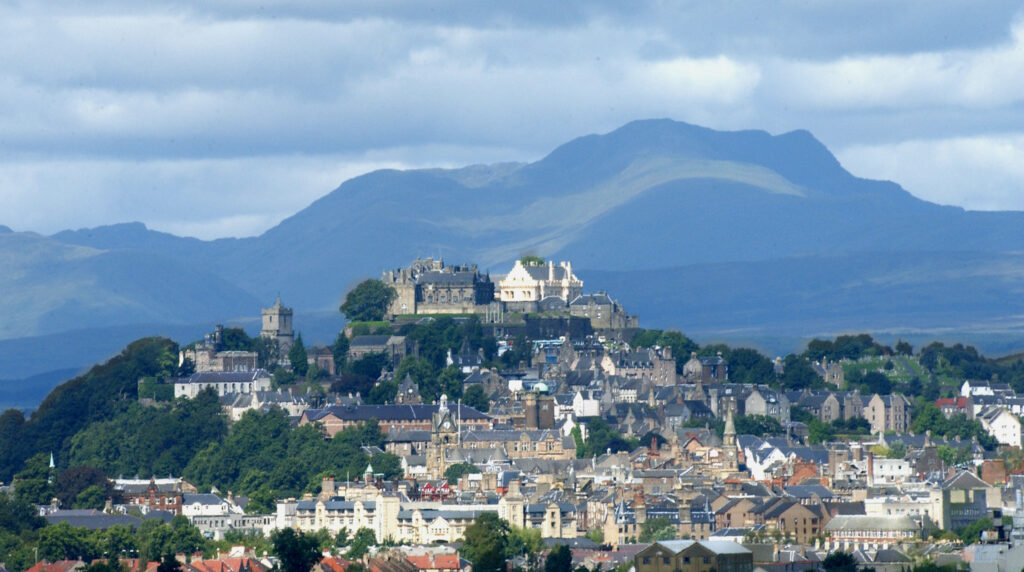
Stirling gets bypassed. Most visitors drive straight through on the M9, heading north to the Highlands or south to Edinburgh. That’s a mistake.
The city sits at the narrowest crossing point of the River Forth, which made it the most fought-over piece of ground in Scotland for centuries. The castle commanded the route north. Whoever held Stirling controlled the country.
Today it’s a compact city of 37,000 people, walkable in an afternoon, with more history per square mile than almost anywhere else in Scotland. And you can park without selling a kidney.
Stirling Castle
The castle sits on a volcanic crag above the old town. It looks like Edinburgh Castle’s less famous sibling, but it’s actually more interesting inside.
The Great Hall was built by James IV in the early 1500s. It’s been restored to its original color scheme: bright yellow walls and a hammerbeam ceiling. The Royal Palace next door has been recreated as it would have looked in 1540, with reproduction tapestries, carved wooden ceilings, and guides in period dress who actually know their material.
Entry is around $22 for adults. The castle opens at 9:30 a.m. daily. Get there before 11 a.m. or after 3 p.m. to avoid the tour groups. The views from the ramparts take in the Wallace Monument, the Ochil Hills, and on clear days, Ben Lomond to the northwest.
The National Wallace Monument
The Wallace Monument is a Victorian tower on Abbey Craig, a hill a mile northeast of the city center. It was built in 1869 to honor William Wallace, who defeated the English army at Stirling Bridge in 1297.
The monument is 220 feet tall. You climb 246 steps on a spiral staircase. There are exhibition rooms on the way up covering Wallace’s life, the Wars of Independence, and the monument’s construction. At the top, you get 360-degree views over the Forth Valley.
Entry costs about $16. It’s open daily from 10 a.m. The last ticket is sold 45 minutes before closing, which varies by season. There’s a free shuttle bus from the visitor center car park to the monument entrance, or you can walk the footpath in about 10 minutes.
Don’t expect historical rigor. The monument leans heavily on the Braveheart mythology, which is historically questionable at best. But the tower itself is impressive, and the view is worth the climb.
Bannockburn and the Old Town
The Battle of Bannockburn site is two miles south of the city center, just off the M9. In 1314, Robert the Bruce defeated a much larger English army here, securing Scottish independence for another few centuries.
The visitor center uses 3D holograms and interactive displays to explain the battle. It’s run by the National Trust for Scotland. Entry is around $15. The battlefield itself is free to walk year-round. It’s flat, open ground with interpretation boards marking key positions.
Back in Stirling proper, the old town climbs the hill below the castle. The Church of the Holy Rude on St John Street has been in continuous use since 1129. James VI was crowned here in 1567 when he was 13 months old. The church is open to visitors most afternoons in summer, free entry.
Mar’s Wark on Castle Wynd is a ruined Renaissance palace from 1570, never finished. Argyll’s Lodging next door is a restored 17th-century townhouse, one of the best-preserved in Scotland. It’s included in your castle ticket.
Practical Details
Stirling is 36 miles from Edinburgh, 28 miles from Glasgow. Trains run hourly from both cities, taking 50 minutes from Edinburgh and 35 from Glasgow. Tickets cost $10 to $15 each way.
If you’re driving, parking at the castle costs about $8 for four hours. There’s cheaper street parking in the old town if you’re willing to walk uphill.
For food, the Portcullis on Castle Wynd does reliable pub lunches. Brea on Baker Street serves good coffee and cakes. The River House on Castle Business Park has views over the Forth and does decent seafood, though it’s a 10-minute walk from the center.
You can see the main sights in a full day. If you want to walk the battlefield or explore the old town properly, stay overnight. The city makes a good base for day trips to Loch Lomond, the Trossachs, or Fife.
Stirling doesn’t get written about much. It should. It’s manageable, interesting, and cheaper than Edinburgh. Sometimes the places people drive past are the ones worth stopping for.
Get one story like this in your inbox every morning. Subscribe to The Ultimate Scotland Travel Guide newsletter.
Tours & experiences in Scotland


Powered by Viator. Some links are affiliate links — we may earn a small commission at no extra cost to you.